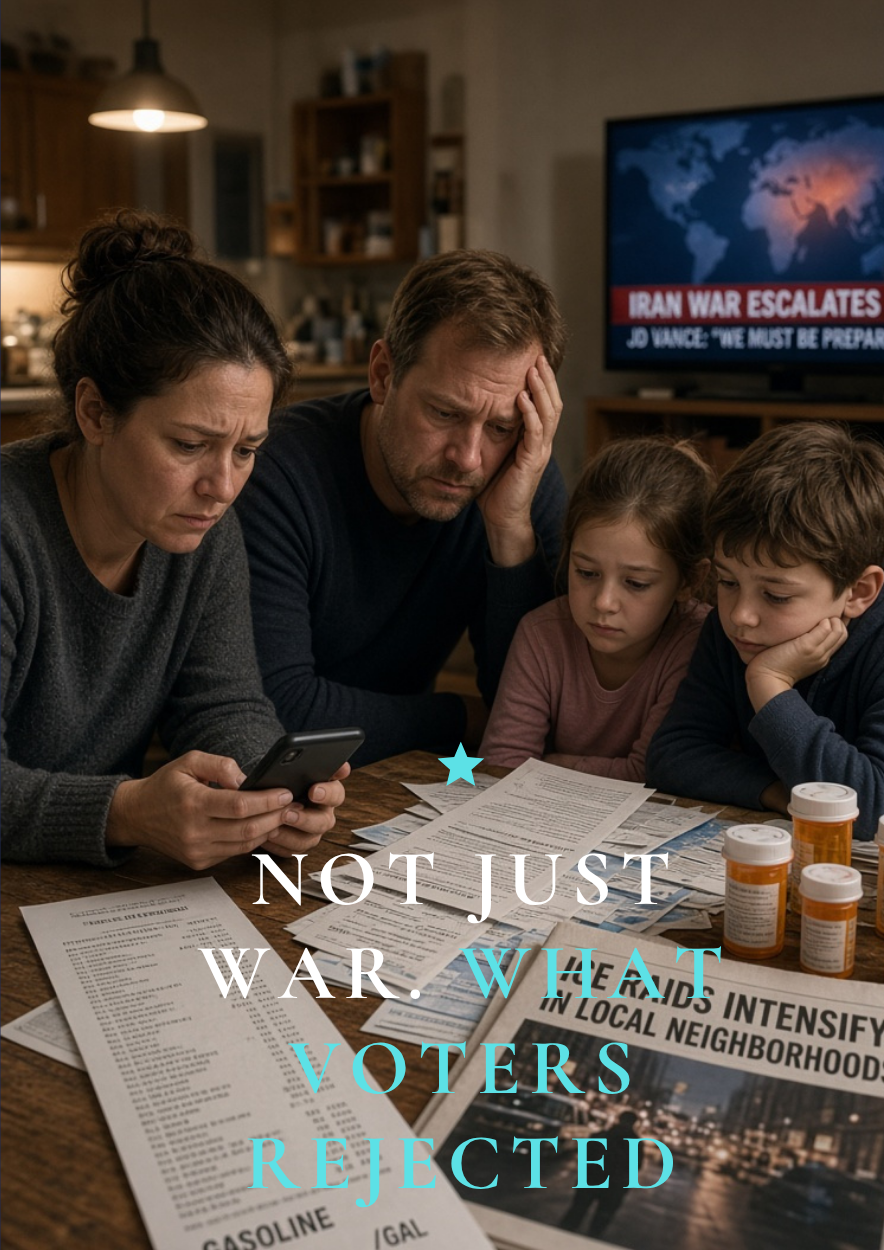
Vice President JD Vance said that Republicans lost both chambers of Congress for one simple reason: the war with Iran. In his post-election post on X, he declared, “The reason we lost is the war,” adding that any honest conversation must start there and that losing the Senate for six years might not have been “worth it.” He listed four things voters who flipped from Trump/Vance in 2024 to Democrats in 2026 wanted: end the war, focus on the cost of living and inflation, put America First, and change the U.S. relationship with Israel. That framing is convenient. It treats a foreign conflict as the singular culprit while downplaying the everyday economic squeeze, the visible excesses of immigration enforcement on American streets, lingering questions about elite accountability in the Epstein files, and the persistent struggle to afford medicine. This statement also raises the question as to whether the Vice President is trying to frame a new argument and perspective if in 2028 he decided to launch a Presidential bid. But again, there’s another big question in the room, can he build a MAGA coalition the same way as Pres Trump did in his two terms.
But right now, the Midterms had changed the game. The data tells a broader story.
Exit polls and pre-election surveys consistently put the economy and cost of living first. In most exit polls and surveys, roughly 39 percent of voters named the economy the most important issue; nearly nine in ten called the cost of living a crucial or major factor. About three-quarters said inflation had caused them or their families severe or moderate hardship. Large majorities were concerned about the price of gas and diesel, groceries, and utilities. Two-thirds or more blamed President Trump’s policies for high prices. The Iran war mattered—exit polling showed roughly six in ten voters thought the U.S. made the wrong decision, and many saw it as a major factor—but it was not the leading issue for most. The war also helped drive up fuel costs, turning a foreign-policy choice into a domestic price problem.
National average regular gasoline hovered around $4.12–$4.15 a gallon in early November 2026, more than a dollar higher than a year earlier, with diesel far higher. Trump himself has acknowledged the short-term pressure on gasoline from the conflict. For families filling tanks, stocking pantries, and paying utility bills, that is not abstract geopolitics. It is the reason the fridge is emptier and the commute costs more. It seems the Vice President assessment fall short on what really hurts the American voters: right on their pockets. Vance’s own list puts cost of living second; elevating the war as the singular cause minimizes the economic message voters sent.
Immigration enforcement produced its own backlash. Pew Research found in October that 56 percent of Americans held an unfavorable view of ICE—the least favorably viewed of the federal agencies measured—with only 35 percent favorable. Exit polling indicated majorities believed the administration’s enforcement had gone too far and disapproved of ICE’s handling of its job. Masked agents, aggressive street operations, and high-profile incidents including the deaths of U.S. citizens during enforcement actions left many Americans uneasy about the sight of federal force in their communities. Latino voters, who had moved toward Republicans in 2024, swung sharply back. This was not abstract policy disagreement; it was discomfort with the methods and scale of enforcement visible on American streets.
The Epstein files added a layer of distrust. Democrats spent tens of millions on ads highlighting incomplete releases, redactions, and questions about accountability for powerful people. Large majorities of Americans, across parties, have said the files illustrate that powerful figures are rarely held to account. Releases under the Epstein Files Transparency Act put millions of pages in public view, yet controversies over withheld material, classified gaps, and the pace of disclosure kept the issue alive. For many voters, this was less about any single name and more about a sense that elite networks operate under different rules. That perception of unaccountable power sits alongside economic anxiety.
Prescription drug affordability remains part of the broader cost-of-living story. While the administration has pointed to recent declines in the Consumer Price Index for prescription drugs and programs like TrumpRx, healthcare costs and access continue to weigh on families. Gallup and other surveys ranked healthcare among the top issues for voters. Claims of progress on list prices do not erase years of high out-of-pocket costs, coverage gaps, or the sense that medicine remains out of reach for too many. Voters who are already stretched by fuel, food, and rent are not easily persuaded that the problem has been solved.
Vance is right that many 2024 Trump voters showed up in 2026 and chose Democrats. His position that the shift happens because of the war, is something that any political analyst will have various takes on because at the end of the day, the War on Iran translate to the War inside every American pockets, in simple terms: Everything is just expensive. The electorate that delivered Democratic control of the House and Senate—flipping seats even in longtime Republican territory—was responding to higher prices at the pump and grocery store, discomfort with aggressive ICE tactics in American communities, incomplete accountability on the Epstein files, and the ongoing difficulty of affording medicine and other basics. Those are kitchen-table realities. Treating the war as the master explanation lets the administration sidestep the domestic failures that most clearly shaped the result. An honest conversation starts with the prices families actually pay and the government actions they actually see. Voters also had shown within the Democrat establishment there is a rising power, a new wave of Democrats who believes that their voices needs to be heard by the mainstream Democrats because they also have the power to determine the election trajectory.